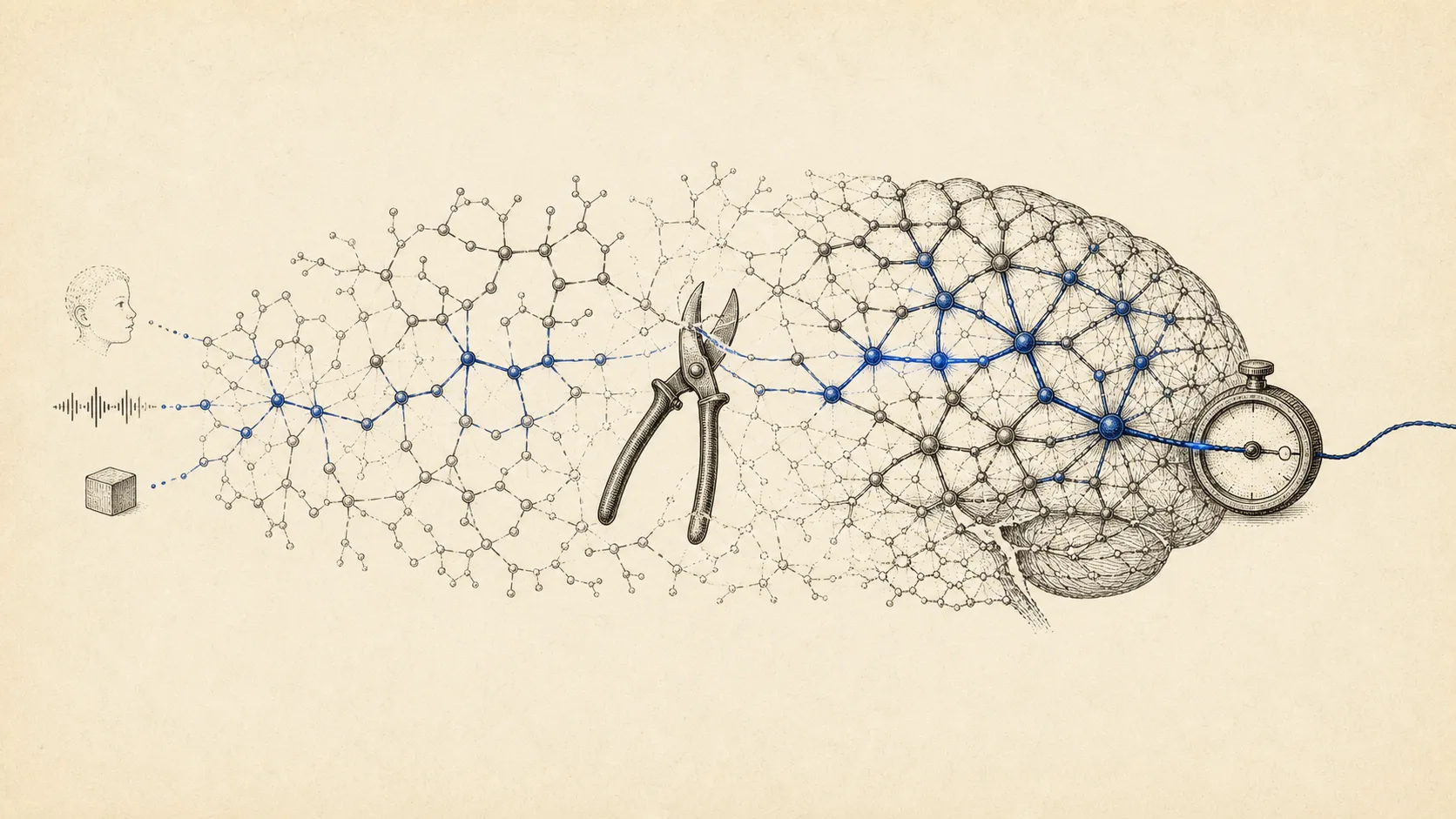
There is an irony in the history of artificial intelligence. We built neural networks inspired, in a radically simplified way, by the brain. Now we use those same networks as metaphors for understanding the brain itself.
One of the most productive analogies is to think of human development as the training of a model.
During childhood and adolescence, the brain goes through an unusually intense period of formation and reorganization. New connections appear, some grow stronger, and others disappear. Repeated experiences alter circuits. Behaviors that produce certain outcomes tend to be reinforced, while patterns that go unused can weaken. The resemblance to training a neural network is hard to ignore.
An artificial network begins with an architecture capable of learning, but it does not yet know how to represent the world well. It is exposed to enormous quantities of information, and each example nudges its parameters. Certain representations gradually become more stable. The system stops merely reacting to isolated examples and begins to recognize patterns.
Something similar happens to us.
Childhood could be compared, with all the limitations of the metaphor, to a kind of biological pretraining. Long before anyone gives us explicit instructions about most things, we continuously absorb regularities from the environment: faces, sounds, language, spatial relationships, social behavior, cause and effect. Much of this learning does not require anyone to tell us the correct answer. The brain observes the world and builds internal models that help predict it.
In that respect, early human learning resembles what we now call self-supervised learning.
Reinforcement learning offers another parallel. Some behaviors bring rewards. Others lead to discomfort, disapproval, or no reward at all. The organism gradually learns both a representation of the world and policies for acting within it. Dopamine participates in some of these reward and prediction-error mechanisms, though reducing all human behavior to reinforcement learning would be a crude simplification.
Adolescence makes the analogy more interesting.
During this period, the brain accumulates new connections while undergoing intense reorganization and synaptic pruning. Connections that are rarely used may disappear, while frequently activated circuits become more efficient.
For anyone familiar with machine learning, the comparison with regularization, pruning, or network optimization is hard to resist.
The brain keeps learning from within a functional architecture that has become much more stable. This suggests another extension of the analogy: the transition from pretraining to post-training.
After its initial training, a large language model already contains a vast structure of representations. Post-training adjusts behaviors, preferences, and responses on top of that foundation.
Adult life may work in a similar way.
We continue to learn, of course. The brain remains plastic throughout life. New experiences can change beliefs, habits, skills, and even neural structures. But that learning takes place inside a network that already carries decades of prior training.
Each new experience encounters weights laid down by everything that came before.
Our education, families, early environments, rewards, traumas, successes, failures, and relationships form the state from which we interpret every new situation.
This also helps explain why changing certain patterns in adulthood can be so difficult. A new piece of information must compete with representations that have been reinforced thousands or millions of times.
The comparison sharpens around memory.
Machine learning has a problem known as catastrophic forgetting. As a model continues training on new data, it can learn the new material while destroying part of what it learned before. Researchers in continual or lifelong learning study how to build systems that keep learning without losing earlier knowledge.
The human brain appears to rely on mechanisms that artificial networks have yet to reproduce. We sleep, consolidate memories, forget selectively, reinterpret old experiences, and continue updating our internal model of the world.
Keywords
human developmentbrain plasticityneural networkspretrainingpost-trainingself-supervised learningreinforcement learningsynaptic pruningcontinual learningcatastrophic forgetting