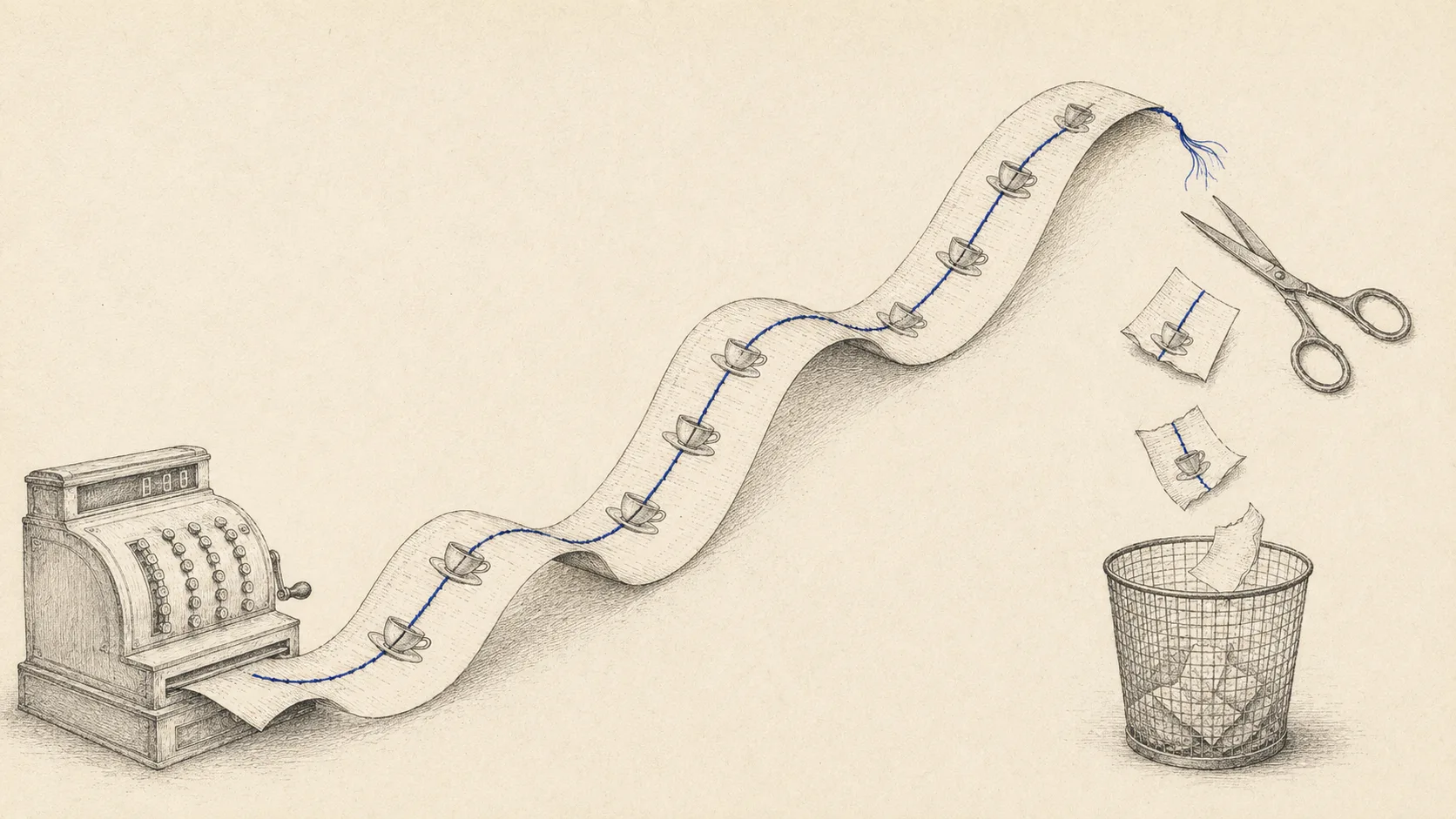
For a few years now I have bought groceries online from the website of a supermarket that also exists down the street, with carts and checkout lanes and a bakery smell. I sign in with my account, so every order is attached to my name. Week after week the orders look remarkably alike: the same coffee, the same rice, the same fruit, the same brand of yogurt. The list barely changes from one week to the next.
By now, that store holds one of the most intimate datasets anyone has about me. It knows what I eat, what I stopped eating, when my consumption changed, how often I restock, and roughly what my month costs. A grocery history is an honest record of how someone actually lives.
And what does the store do with it? As far as I can tell, nothing. The newsletter that reaches my inbox is the same flyer everyone receives, a wall of products I have never bought. The coffee I purchase every single month went on sale recently, and nobody told me. When I return to the site, it greets me like a stranger. Every week I hand the store a chapter of my life, and every week it starts our relationship from zero.
This essay is about that silence. It is not a story about a company lacking data, because the data is all there, collected at every checkout. It is a story about an industry that gathers memory and declines to remember.
The grocer used to know
Business intelligence in food retail is older than the term. A century ago, the corner grocer ran the whole discipline in his head: he knew that Dona Helena's family doubled its flour before holidays, that the young couple on the corner had switched to a cheaper cut of meat, that a regular had stopped coming and someone should ask after him. He extended credit on the strength of a purchase history he could recite from memory. His analytics were a ledger and a good eye, and they bought him the loyalty every retailer says it wants today.
Scale broke that. Supermarkets traded the grocer's memory for lower prices and wider aisles, and the customer became anonymous foot traffic. The entire promise of retail technology, from the loyalty card to the e-commerce login, was that computers would give the memory back: a chain with a million customers could know each one the way the grocer knew a hundred.
The strange part is that the promise was kept, spectacularly, three decades ago. Then most of the industry filed the proof away and kept sending generic flyers.
Solved in 1994
In 1994, Tesco was the second-place grocer in the United Kingdom. It hired a small data firm called dunnhumby to analyze the shopping histories flowing through a loyalty-card trial. When the results were presented to the board, the chairman, Lord MacLaurin, said: "What scares me about this is that you know more about my customers after three months than I know after 30 years."1
Tesco rolled the Clubcard out nationally in 1995. Within a year it had overtaken Sainsbury's as the country's largest grocer; within three, its market share had roughly doubled; by 1997 its mailings were personalized down to the individual shopper.2 This was accomplished with mid-nineties hardware, postal mail, and paper coupons. Whatever excuse a retailer reaches for today, whether cost, complexity, or technology, has to survive the fact that the problem was solved before most of today's e-commerce platforms existed.
The fear that became an alibi
There is a famous counterweight to the Tesco story. In 2012, Charles Duhigg reported that the American retailer Target had built a model that could infer, from about twenty-five products, that a shopper was pregnant, and even estimate her due date.3 The story that traveled the world attached to it, in which a father discovers his teenage daughter's pregnancy through the coupons Target mailed her, was never verified and is, by the best accounting available, closer to legend than to fact.4 But the legend did its work. "Personalization" acquired a creepy twin, and every under-invested retailer gained a respectable-sounding reason to keep sending the generic flyer: we wouldn't want to be like Target.
The alibi does not hold, because the two behaviors are not on the same axis. Inferring an undisclosed pregnancy is surveillance of what a customer never chose to share. Telling me that the coffee I have bought openly, monthly, under my own name, is on sale this week is almost the opposite gesture: it uses only what I have plainly shown, to my obvious benefit, in a way I would thank the store for. Conflating the two is how an industry talked itself into treating its customers' routines as radioactive instead of useful.
The vacuum
The numbers on what came after are humbling. A 2021 McKinsey study found that 71 percent of consumers now expect personalized interactions and 76 percent are frustrated when they don't get them; done well, personalization typically lifts revenue by 10 to 15 percent.5 Meanwhile, research by Incisiv finds that only about 4 percent of grocers have reached an advanced stage of personalization maturity: the transaction data sits in one system, the loyalty program in another, the app in a third, and none of them assemble into a person.6 The default remains the mass promotion, which quietly teaches shoppers that every store is interchangeable with every other, since a generic 10 percent off looks identical everywhere.7
Where I live, in Brazil, the ritual has its own flavor. At every checkout the cashier asks for your CPF, the national taxpayer ID, and millions of us recite it, attaching our identity to every receipt. The collection side of the machine works flawlessly. What almost never arrives is the other half of the bargain: the moment when all those identified receipts come back to the customer as anything at all, whether a relevant offer, a restock reminder, or a sign that anyone noticed the routine we have been depositing at the register for years.
It has never been cheaper to remember
I am sensitive to the objection that this is hard, so it may help to say that I have built a version of it with public data and free tools. My degree capstone took the open dataset of a Brazilian e-commerce marketplace and assembled a business-intelligence pipeline that predicts which orders will end in a negative review: a warehouse, dashboards, and two competing models, produced by one student on one laptop. The techniques a supermarket would need to notice that my coffee is on sale are older and simpler than that.
And the cost curve keeps collapsing. The hard parts of turning a purchase history into a helpful message (segmenting, phrasing, timing, restraint) are precisely the parts that language models have turned into a commodity. A mid-sized grocer in 2026 has, off the shelf, capabilities that dunnhumby had to invent from scratch in 1994. The missing ingredient was never capability. It is the decision to treat the record a customer leaves behind as a relationship rather than exhaust.
Coda
I write, elsewhere on this site, about systems that remember people wrong: assistants whose memories harden a passing remark into a permanent belief. My supermarket has the opposite disease, and it may be the stranger one. It holds a memory of me that is perfect, consented to, and verified at the cash register, a record with no hallucinations in it at all. It simply chooses amnesia, every single week.
The corner grocer would not recognize the technology, but he would recognize the failure instantly: a shopkeeper who cannot remember his regulars. Continuity, it turns out, is not a feature stores lost the ability to build. It is a courtesy they stopped extending, and the first grocer in my city to extend it again will get what Tesco got.